


Vajrayana on the Eastern Coast: Why the Diamond Triangle Flourished Late
- Soumyaranjan Sahoo

- Feb 24
- 5 min read
The period between the 7th and 10th centuries CE is frequently portrayed as the terminal phase of Buddhism in the Indian subcontinent. This framing, shaped by narratives of political disruption and institutional disappearance, obscures regions where Buddhism did not merely persist but reorganised itself into more complex ritual and institutional forms. Odisha’s Diamond Triangle—Lalitgiri, Ratnagiri, and Udayagiri—belongs firmly to this category.
The most intensive phase of architectural construction, sculptural production, and ritual elaboration at these sites occurs late, not early. This was not a delayed echo of earlier centres such as Nalanda but a response to a transformed Buddhist world shaped by Vajrayana ritual, transregional mobility, and regional political ecologies.
Vajrayana as a Structural Reorientation of Buddhist Institutions

Vajrayana Buddhism represented a structural reordering of Buddhist institutional life rather than a marginal doctrinal layer added to Mahayana foundations. Gregory Schopen’s critique of text-centric Buddhist historiography remains foundational in this regard. In Bones, Stones, and Buddhist Monks, Schopen argues that late Buddhist monasteries functioned as “corporate ritual institutions concerned with initiation, property, and lineage transmission,” a formulation that shifts attention from philosophy to practice.
The monasteries of the Diamond Triangle align closely with this model. Excavated plans reveal controlled entry points, shrine-centric movement, and differentiated spaces for residence, ritual, and instruction. Such spatial organisation reflects the requirements of Vajrayana initiation systems, which depended on hierarchical progression, restricted access, and repeated ritual performance rather than open scholastic debate.
Eastern India, Maritime Networks, and Late Buddhist Mobility
The late florescence of Vajrayana in Odisha cannot be understood without situating the region within the Bay of Bengal world. From the seventh century onward, maritime networks intensified across eastern India, Sri Lanka, and Southeast Asia. Himanshu Prabha Ray’s work on seafaring and religion demonstrates that Buddhist monasteries along riverine and coastal corridors functioned as nodes within these exchange systems. She notes that such institutions acted as “anchoring points for itinerant monks and ritual specialists moving across maritime routes.”
Although the Diamond Triangle lies slightly inland, its proximity to the Brahmani–Baitarani river system positioned it firmly within these circuits. This location allowed ritual institutions to maintain controlled environments while remaining connected to transregional flows of texts, icons, and practitioners. Vajrayana, with its emphasis on lineage transmission, benefited directly from such mobility.
Political Ecology and Late Patronage in Odisha
Unlike Nalanda or Vikramashila, which depended heavily on imperial patronage, Odisha’s Buddhist institutions developed within a polycentric political landscape. Hermann Kulke characterises early medieval Odisha as a region where religious establishments drew support from multiple local elites rather than a single sovereign authority. This dispersed patronage created institutional resilience.

Archaeological stratigraphy at Ratnagiri and Udayagiri shows repeated renovation phases rather than abrupt abandonment. Historian B.D. Chattopadhyaya’s observation that early medieval religious change involved “reorientation of patronage rather than replacement of belief” corresponds closely with the material record from the Diamond Triangle. Vajrayana institutions adapted to shifting political conditions without institutional collapse.
Voices from Excavation: What the ASI Recorded
The Archaeological Survey of India’s excavation reports provide direct evidence for the late florescence of Buddhism in Odisha. The Ratnagiri excavation report (1958–61) describes the site as:
“a vast monastic establishment with multiple viharas, shrines, and stupas, exhibiting a long sequence of occupation and repeated structural modifications.”
The emphasis on continuity and modification contradicts narratives of decline. The report further notes that the volume and variety of sculptures recovered “suggest sustained religious activity rather than sporadic patronage.”
Similarly, ASI documentation from Udayagiri (1985–89; 1997–2003) refers to:
“clearly demarcated residential and ceremonial zones, with iconographic placement following axial and cardinal principles.”
Such phrasing is significant within ASI’s typically restrained descriptive language, indicating archaeologically recognisable ritual intentionality. Debala Mitra, reflecting on these findings in Buddhist Monuments, concluded that:
“The sculptural wealth and architectural arrangement at Ratnagiri cannot be explained without assuming the presence of advanced ritual practices.”
Site-Wise Iconographic Catalogue I: Ratnagiri as the Vajrayana Core
Ratnagiri constitutes the most intensive Vajrayana locus within the Diamond Triangle. Excavations yielded a high concentration of tantric imagery, including multiple forms of Tara, Vajrasattva, fragmentary Heruka figures, and Dhyani Buddhas arranged in cardinal niches around stupas. The repetition and standardisation of these forms indicate long-term ritual continuity.

Art historian T. Richard Blurton described Ratnagiri as “one of the most complete archaeological laboratories for institutional Vajrayana in India,” emphasising the convergence of architecture, iconography, and spatial logic. Susan L. Huntington similarly observed that the sculptural programmes at Ratnagiri functioned as “visual manuals for ritual hierarchy,” guiding practitioners through embodied forms of doctrinal transmission.
Site-Wise Iconographic Catalogue II: Udayagiri and Ceremonial Order
Udayagiri complements Ratnagiri through scale and spatial clarity. Key features include large seated Dhyani Buddhas aligned along cardinal axes, controlled shrine access, and a clear separation between residential and ceremonial zones. ASI reports consistently stress this spatial differentiation, indicating a carefully ordered ritual environment rather than a generic monastic settlement.

The iconographic programme at Udayagiri suggests an emphasis on ceremonial regulation and collective ritual performance, reinforcing its role as a stabilising counterpart within the clustered Vajrayana landscape.
Site-Wise Iconographic Catalogue III: Lalitgiri and Relic Authority
Lalitgiri anchors the Diamond Triangle historically through its relic deposits. Nested relic caskets of stone, steatite, silver, and gold represent one of the most significant Buddhist relic discoveries in eastern India. ASI documentation confirms that these were recovered in situ, establishing primary ritual context.
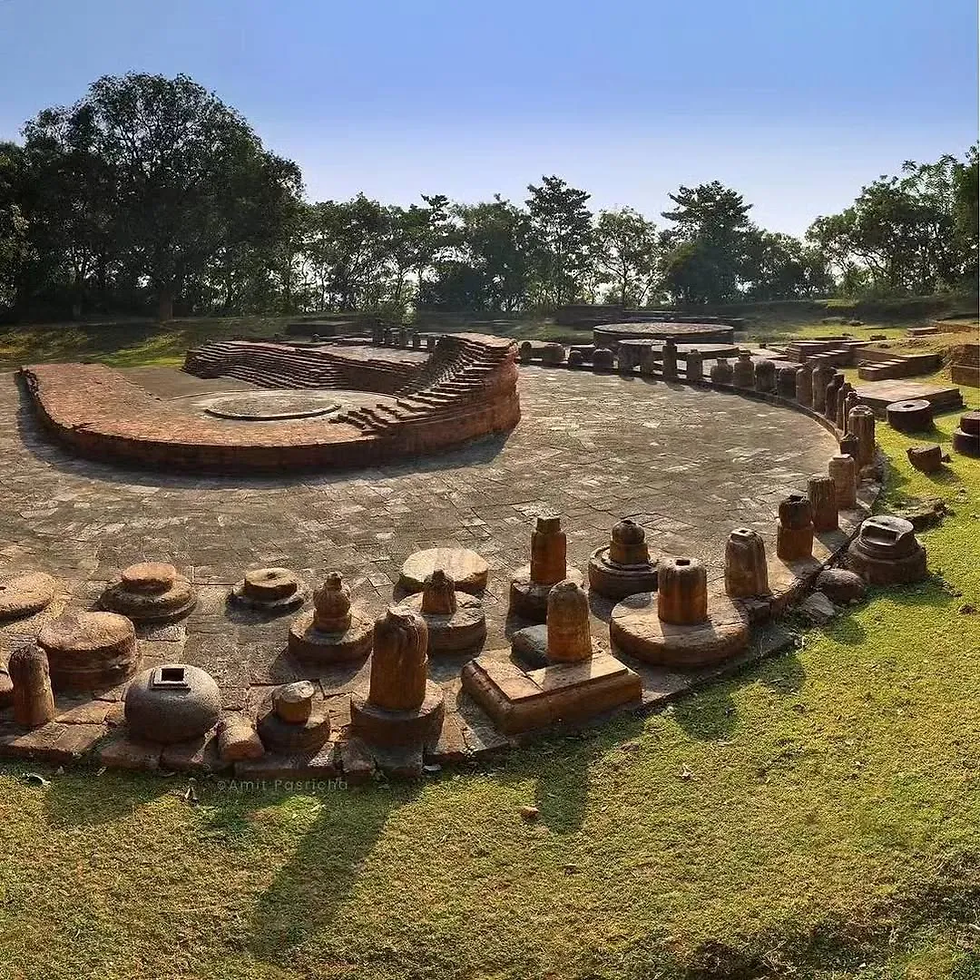
While Vajrayana imagery is less prominent here, Lalitgiri preserves earlier devotional traditions that continued to legitimise later ritual developments. Debala Mitra characterised Lalitgiri as “a transitional node where early relic veneration and later monastic expansion intersect,” underscoring its role in maintaining historical continuity.
Distributed Vajrayana and the Logic of Clustering
Read together, Lalitgiri, Ratnagiri, and Udayagiri reveal a distributed institutional logic. Ratnagiri intensifies ritual experimentation, Udayagiri stabilises ceremonial order, and Lalitgiri supplies relic-based authority. Dilip K. Chakrabarti’s concept of “federated monastic landscapes” provides a useful analytical frame, describing systems in which authority circulates across multiple sites rather than residing in a single centre.
This model aligns closely with Vajrayana’s reliance on lineage, initiation, and spatial differentiation, explaining why clustered landscapes proved especially conducive to late Buddhist practice.
Late Buddhism and the Myth of Decline
Recent scholarship has decisively challenged the equation of late Buddhism with decline. Tansen Sen argues that from the seventh century onward, Indian Buddhism’s vitality must be assessed through its outward transmission rather than its territorial dominance. Vajrayana institutions in Odisha served as hubs for the transmission of ritual knowledge that travelled to Tibet and Southeast Asia, even as political conditions within India shifted.
The Diamond Triangle’s sculptural sophistication and architectural investment reflect confidence and institutional strength. The relative absence of large libraries indicates an epistemological shift toward embodied and initiatory transmission rather than intellectual exhaustion.
Late Flourishing as Historical Strength
The Diamond Triangle flourished late because it emerged at the intersection of Vajrayana ritual requirements, eastern India’s maritime connectivity, and Odisha’s polycentric political ecology. Archaeological evidence, ASI documentation, and interdisciplinary scholarship converge on a single conclusion: Vajrayana on the eastern coast represents a mature, adaptive phase of Buddhism rather than a residual survival.
Understanding this late florescence restores Odisha to its rightful place within the history of Buddhist innovation and challenges linear narratives of rise and decline.
Reference
Archaeological Survey of India, Excavation Reports: Ratnagiri (1958–61)
Archaeological Survey of India, Udayagiri Excavations (1985–89; 1997–2003)
Mitra, Debala. Buddhist Monuments. Sahitya Samsad
Schopen, Gregory. Bones, Stones, and Buddhist Monks. University of Hawai‘i Press
Blurton, T. Richard. Buddhist Art and Architecture. British Museum Press
Huntington, Susan L. The Art of Ancient India. Weatherhill


Comments