


The Long Now of Us: Jagannath Panda’s Homecoming and His First Solo Exhibition in Odisha
- Soumyaranjan Sahoo

- Feb 14
- 4 min read
For an artist whose practice has travelled across continents, museums, and biennales, returning home is never a simple act of looking backwards. It is an encounter with time itself.
The Long Now of Us marks a deeply significant moment in the career of Jagannath Panda, his first-ever solo exhibition in Odisha, opening in Bhubaneswar after nearly three decades of international recognition. More than a milestone, the exhibition unfolds as a layered homecoming, situating Panda’s expansive contemporary practice within the cultural soil that first shaped his artistic consciousness.

Curated by Sibdas Sengupta, the exhibition resists the logic of a conventional retrospective. Instead, it operates as a living archive, a constellation of images, materials, gestures, and memories that recur across Panda’s work. Time here is not linear. It is cyclical, returning, folding back on itself, allowing past, present, and future to coexist.
Sengupta frames this approach as a “practice of return”: an ethical commitment to revisiting lived experience, cultural memory, and ecological landscapes not as completed histories but as processes still in formation.
A Chariot of Memory: Architecture as Body, Archive as Movement
At the heart of the exhibition stands a monumental installation titled The Worlds That We Drift Together. Constructed from cut-out wood and fabric, the chariot-like structure functions simultaneously as sculpture, archive, and moving body. Books, photographic fragments, and small sculptural objects are embedded within its compartments like testimonials of lived time.

Integral to the installation are rice grains and terracotta forms, elements that evoke gestures of holding, losing, and offering. These terracotta objects operate doubly: as excavated relics emerging from mounds of grain, and as symbolic anchors asserting a deep capacity for collective preservation. The chariot, long embedded in Odisha’s cultural imagination, is re-envisioned here not as a static monument but as a vehicle of adaptation and extraction, continuously regenerating and collapsing toward the future.
Photographs of Odissi dancers appear throughout the structure, acting as yakshyas of the chariot, awakening its mutational capacity. Sculptural objects emerge from photographic references, emphasising the frozen quality of images as evidentiary traces. Wheels suggest perpetual motion; spatial divisions fracture and reassemble. The installation becomes both witness to multiple pasts and vessel of knowledge for a potentially sustained future.
Drawing on Jacques Derrida’s notion of “archive fever,” the work resists traditional archival authority. Preservation here is inseparable from loss, mutation, and desire.
History, Panda suggests, is not a settled record. It is a modular assemblage.
Bodies in Rhythm, Images in Return
Spanning mixed-media painting, sculpture, and drawing, the exhibition repeatedly returns to bodily movement as a form of knowledge.
In Born and Unravelled II, the mirrored figure of a dancer, reproduced, frozen, and reflected, captures both the absurdity and playfulness inherent in image production. Rhythm emerges as a reservoir of embedded memory, suggesting circularity as a vital expression of the self’s autonomy.

Across drawings and paintings, Panda imagines the chariot as mathematical mobility, almost as messages to another world. Miniature cut-outs, patterned fabrics, and recursive compositions divide space through superimpositions, dissolving boundaries between measurement and erasure, resolution and fragmentation.
Ultimately, these works propose that every slice and stitch becomes a transformative gesture of making different worlds.
The Gardener, the Spectacle, and the Politics of Seeing
In The Gardener of the World IV, Panda introduces a figure behind spectacles, a gardener-farmer-performer who prompts a fundamental question: who truly oversees the cultivation of reality?
Here, spectacles operate as epistemic filters, invisible frameworks that categorise and validate what we perceive as “truth” while discarding the rest. Referencing Jonathan Crary’s observation that vision is historically produced rather than naturally given, Panda treats the spectacle not as enhancement but as an epithermic veil.
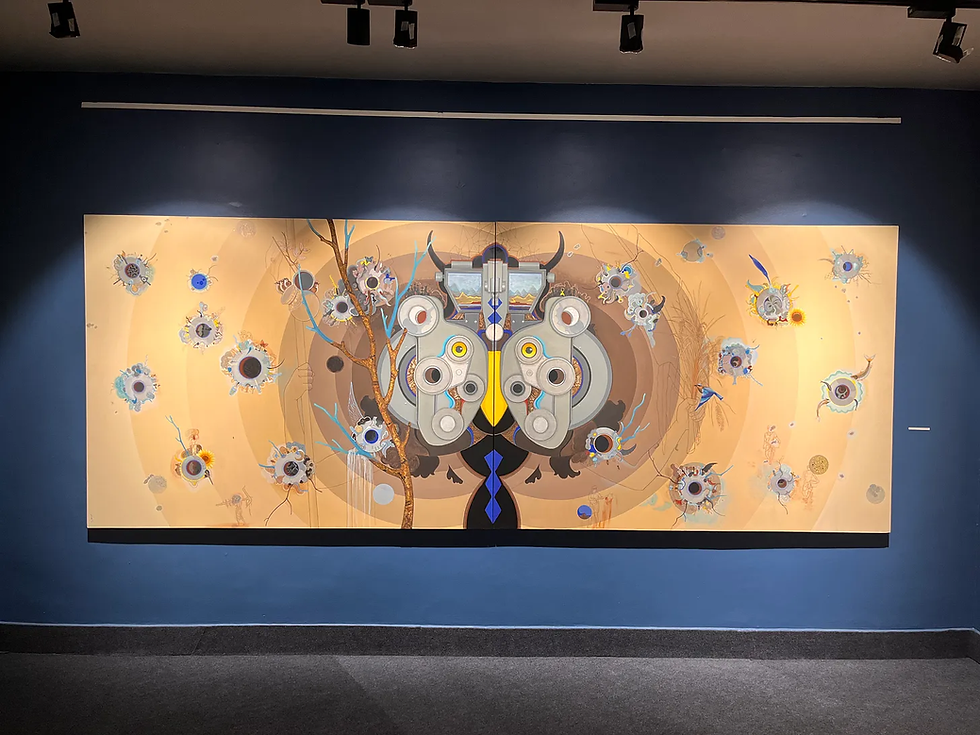
The gardener becomes both cultivator and subject. The act of seeing turns ritualistic. Identity dissolves into myth. The figure transcends mundane presence to become something that haunts and reshapes time.
Multiple worlds coexist simultaneously, Panda suggests, and only by discarding the apparatus altogether can perspective truly shift.
Vernacular Knowledge and Odisha as Origin
Presenting this body of work in Bhubaneswar carries particular resonance.
Panda’s artistic consciousness has been profoundly shaped by Odisha’s regional traditions. Ravana Chhaya, Pattachitra, Dokra metalwork, Odissi and Gotipua dance forms recur throughout his practice. Outside the region, these elements often appear abstract or ambiguous. Within Odisha, they become familiar yet deliberately decontextualised, enabling new narratives to emerge beyond static symbolism.

Referencing Gopinath Mohanty’s cyclical conception of time and dialectical storytelling, Panda constructs counter-narratives where mythical beings, fragmented objects, and ruptured representations accumulate residues of lived experience. The chariot becomes a cultural symbol carrying palimpsestic traces across past, present, and future.
His practice oscillates between Gurgaon–Delhi NCR’s rapid urban homogenisation and his deep connection to native cultural grounding. These tensions coexist within his broader artistic language.
A Collective Pause: Art in Entrepreneurial Space
The exhibition is presented in collaboration with Entrepreneurs’ Organisation Odisha, positioning The Long Now of Us as a moment of collective pause for founders and leaders.
Rather than treating contemporary art as patronage, EO Odisha frames this engagement as participation in culture, inviting reflection on long-term thinking, responsibility, and stewardship. It opens dialogue between art and enterprise, between strategy and memory.
Leadership, like Panda’s practice, exists between momentum and meaning.

More Than a Milestone
The Long Now of Us is not simply Jagannath Panda’s first solo exhibition in Odisha. It is a return that acknowledges inheritance and invention, rupture and continuity.
Through the chariot’s movement, the dancer’s rhythm, the archive’s fracture, and the spectacle’s filter, Panda asks us to reconsider how knowledge travels through bodies, materials, and landscapes. Ecological crises appear not as immediate ruptures but as zones of contemplation, where preservation emerges through tradition and indigeneity.
History, here, is never finished. It is always still being assembled.


Comments