


Between Ritual and Celebration: Where do we draw the line? Or should we not?
- Soumyaranjan Sahoo

- Sep 29, 2025
- 6 min read
Festivals are among the most visible expressions of culture. They are not a simple pause from routine or a decorative embellishment on the calendar; they are condensed symbols of how a society understands itself. In India, where religion, ritual, and the rhythms of everyday life are interwoven, festivals function both as mirrors and moulds — they reflect what we are and simultaneously shape what we can become. They hold within them the duality of continuity and change, demanding that we look deeper into how societies remember, belong, and evolve.
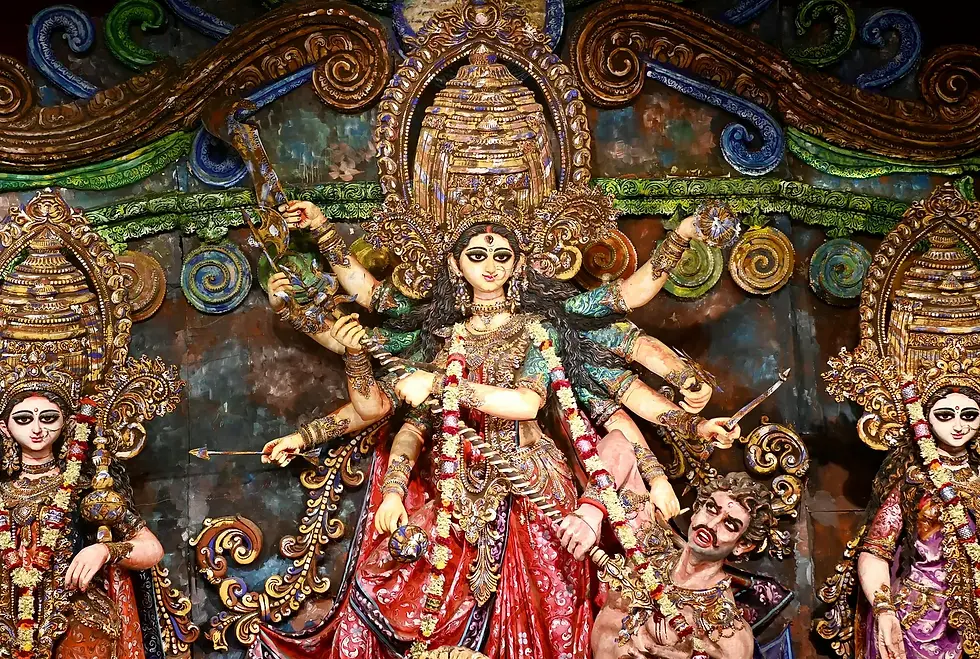
And yet, when one observes closely, a subtle divide runs through our festive life. There are those who throw themselves completely into celebration — joy expressed through music, laughter, sweets, colours, and community gatherings. And there are those who lean into ritual, repetition, and discipline — finding meaning not in spectacle but in the measured continuity of order, tradition, and symbolic practice. It often appears as if these two ways of experiencing a festival stand on opposite ends of a line.
These two groups, the celebrants and the ritual-keepers, often misunderstand each other. The celebrant sees the other as rigid or joyless. The ritual-keeper sees the celebrant as reckless or shallow. What is lost in this mutual suspicion is the recognition that both forms are essential, that festivals cannot be confined to either unrestrained celebration or strict ritual. Their vitality lies precisely in the tension between them, which brings us back to the question: should we be drawing a line at all, or should we instead see this interplay as the very essence of cultural life?
Childhood, Labels, and the Formation of Belonging
For many of us, this tension is not abstract; it is lived. From childhood, society places us into one of these moulds. Some are encouraged to “go out, play, and enjoy,” while others are rewarded for “staying grounded” and following the rulebook. Labels like Maa ka ladla or Teacher’s Pet may be used half in jest, but they often carve a lasting impression.
The anthropologist Nirmal Kumar Bose once wrote that Indian social life is layered with dualities — asceticism and enjoyment, continuity and change, detachment and participation. These dualities are not contradictions but complements, existing side by side. A child who grows closer to tradition, who thrives on order and repetition, is not necessarily deprived of joy; rather, they embody the continuity that ensures a culture does not dissolve in the flow of time. On the other hand, children who immerse themselves in celebration keep culture vibrant, reminding us that tradition without joy becomes brittle.
And yet, when festivals arrive, comparison often enters. The disciplined child sees the celebrant and feels left out. The celebrant, in quieter moments, suspects that something deeper might be missing. Both carry invisible stings that resurface even in adulthood.
Ritual, Celebration, and the Social Pattern
Émile Durkheim, the French sociologist, famously argued that rituals are society worshipping itself. In the Indian context, scholars like Radhakrishnan and Aurobindo went further — they saw rituals not merely as repetitions but as vehicles of meaning, ways of aligning the human spirit with cosmic order (ṛta).
Sri Aurobindo, in particular, suggested that behind every ritual is a kernel of inner truth, a symbolic act pointing to higher consciousness. When rituals become mechanical, they lose vitality. When celebrations lose grounding, they become fleeting pleasures. Both ritual and celebration, then, need each other — ritual gives celebration depth, while celebration prevents ritual from ossifying.
This pattern — the oscillation between order and abandon — is not unique to India. Anthropologist Victor Turner spoke of “communitas” in festivals: moments where social hierarchies dissolve and people meet as equals, usually in celebration. Yet Turner also noted that once the festival ends, structures return. In Indian society, this rhythm is visible everywhere: the temple bell that marks the hour, the street processions that suspend normalcy, the Diwali lamps that combine prayer with play.
What Does This Mean in the Present?
Today, however, our festivals face new pressures. Consumerism pushes us towards spectacle. Ritual sometimes struggles against charges of irrelevance. The divide between the celebrant and the ritual-keeper can harden into hostility — with one side mocked as backward and the other dismissed as frivolous.
Here, the words of Radhakrishnan are instructive: “Tradition is not to preserve the ashes but to pass on the flame.” The flame requires both fuel and spark — ritual provides the continuity of fuel, celebration provides the spark of joy. If we abandon either, the festival loses meaning.
At a societal level, this means that progress cannot be about deserting traditions in the name of modernity, nor about rejecting joy in the name of purity. True progress lies in recognizing that both impulses — order and spontaneity — are part of the human condition.
Acceptance Without Desertion
How, then, do we move towards a more progressive structure of society?
The key lies in acceptance without desertion. To accept another’s way of celebrating is not to abandon our own. The person who dances in the street and the person who prays in silence are not competitors in authenticity; they are fellow travelers expressing culture in different registers.
Nirmal Kumar Bose once described Indian society as “a system of negotiated coexistence” — not homogeneity, but plurality held together by mutual recognition. That insight applies just as much to our festive lives. A progressive society is not one in which everyone celebrates the same way, but one in which diversity of expression enriches the whole.
Where Do We Go From Here?
To move forward, perhaps we need to ask different questions during festivals. Not: Am I doing it right compared to others? but: What does this act mean to me? Not: Who is missing out? but: How are different ways enriching the whole?
In practical terms, this could mean creating spaces within festivals where both quiet rituals and exuberant celebrations are respected. It could mean teaching children not only the “how” of rituals but also the “why.” It could mean embracing the fact that identity is not one-dimensional — that we can light lamps in reverence in the morning and laugh with abandon in the evening without betraying either impulse.
As Aurobindo reminds us, society evolves not by erasing opposites but by integrating them. The discipline of ritual and the freedom of celebration are not two warring camps but two wings of the same bird. To fly, we need both.
At ParibhaAsha, we see festivals as vital frameworks through which societies express their deepest values and aspirations. Each festival embodies layers of meaning, the reinforcement of memory, the renewal of social bonds, the circulation of economy, and the enactment of symbolic rhythms that connect individuals with their communities.
In these concentrated moments, the structure of society becomes visible, revealing both its resilience and its creativity. Our vision is to explore festivals as living archives that help us understand how people hold on to tradition, adapt to change, and imagine new possibilities. By documenting and reinterpreting these cultural experiences, ParibhaAsha works to highlight festivals as essential to the continuity of life and to the progressive shaping of social fabric.
Life, as said, is not linear. It bends, breaks, and compels us to adapt. The child who once felt the sting of being different may still feel it today, but adulthood offers a new possibility: to reinterpret festivals not as competitions but as conversations. Conversations between past and present, between discipline and freedom, between ritual and joy.
And if we can carry this spirit forward of acceptance without desertion, of balance without erasure, then perhaps our society can progress not by abandoning what is innately ours, but by learning how to hold it alongside what is innately someone else’s.
Festivals, after all, are not about sameness. They are about resonance. And resonance requires many notes.
References
Durkheim, Émile. The Elementary Forms of Religious Life. (1912; English translation by Karen E. Fields, 1995). Free Press.
Turner, Victor. The Ritual Process: Structure and Anti-Structure. (1969). Aldine.
Radhakrishnan, S. The Hindu View of Life. (1927; multiple reprints). HarperCollins/Indus Source.
Aurobindo, Sri. The Foundations of Indian Culture. (First published serially 1918–1921; book form, 1953). Sri Aurobindo Ashram Trust.
Bose, Nirmal Kumar. Cultural Anthropology. (1961). Indian Statistical Institute.
Bose, Nirmal Kumar. Hindu Samajer Gathan o Gati [The Structure and Movement of Hindu Society]. (1949). Calcutta: Basumati Sahitya Mandir.
Das, Veena. Critical Events: An Anthropological Perspective on Contemporary India. (1995). Oxford University Press.


Comments