temple
Chausathi Yogini Temple, Ranipur Jharial
Chausathi Yogini Mandira, Ranipur Jharial
- Bolangir
- deities worshipped here1
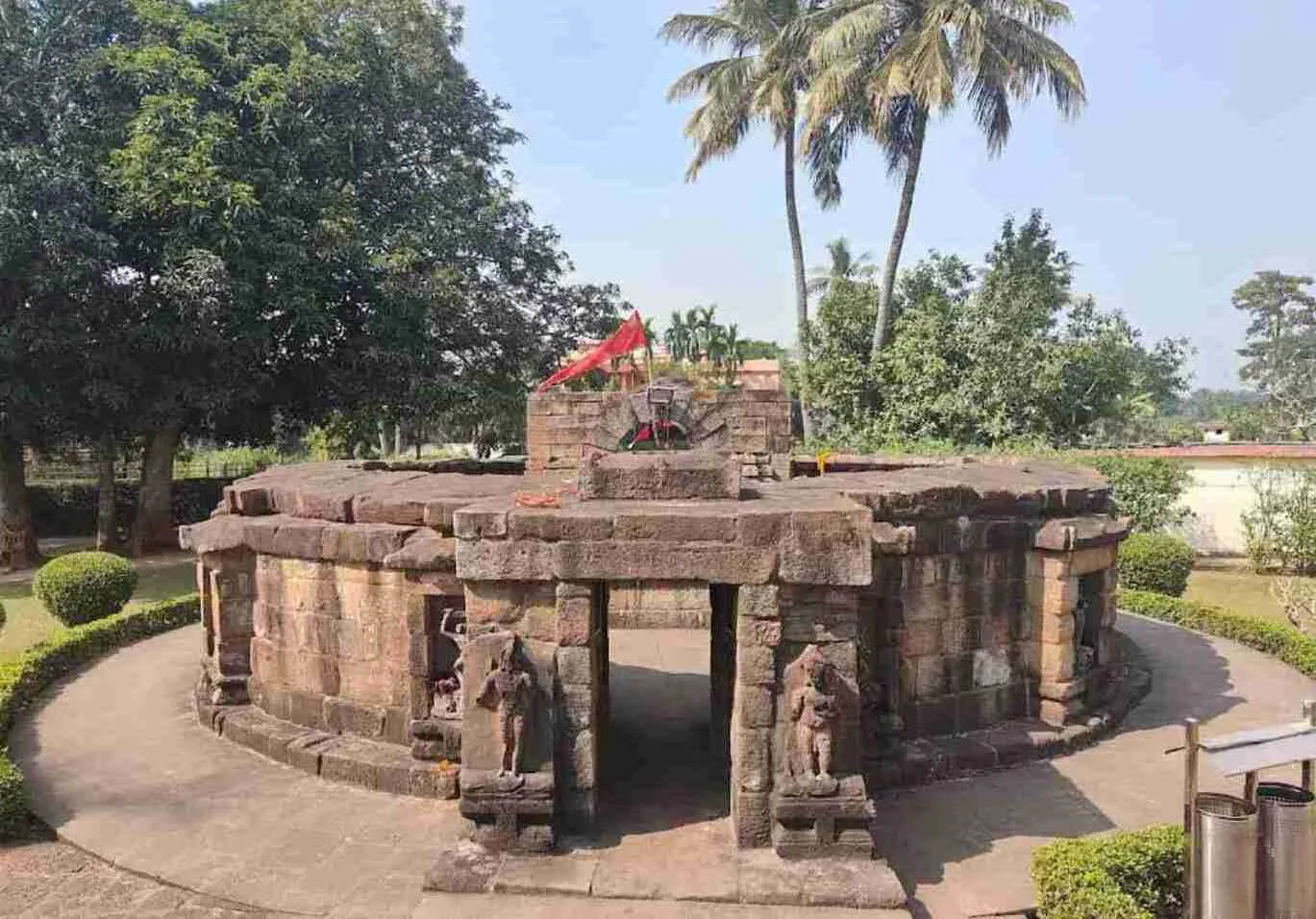
The Chausathi Yogini Temple at Ranipur Jharial, in Balangir district, is a circular, open-air shrine of sandstone about 50 feet across, dedicated to the sixty-four Yoginis. Sixty-two of the images survive, each shown poised to dance. At the centre stands a shrine of Nateshwar, Shiva as lord of dance. It is a protected monument in a remote setting, a few miles from Titilagarh and Kantabanji.
quick facts
- district
Bolangir
- dress code
Ethnic or traditional dress is customary.
know before you go
do
- Check the condition of the last stretch of road before you set out
- Take time to look at the animal-headed Yogini images
- Carry water, as the site is remote and open to the sky
avoid
- Do not touch or lean on the ancient sculptures
- Do not climb on the walls or the rocky outcrop structures
- Do not litter the monument grounds
safety
The site is isolated and open to the sun and rain. Travel in daylight and carry water.
how to reach
The temple is about 25 km from Titilagarh town and about 110 km from Balangir. Titilagarh Junction is the nearest major railway station, with sources giving 32 to 40 km. Hired vehicles are available at Balangir and Titilagarh.
From Balangir the route runs through Patnagarh and Kantabanji, then turns off at Bangomunda. One guide describes the last stretch as an unpaved road, so check conditions before travelling in the rains.
address: Ranipur Jharial, Bangomunda block, Titilagarh subdivision, Bolangir district, Odisha
history and significance
why it matters
It is the first Yogini temple to have been discovered, described by Major-General John Campbell in 1853, and one of the few open-air circular Yogini temples in India. Its images are unusual because all are shown in dance poses, and there are no Matrikas among them. The Yogini temples of Hirapur, Mitaoli, Khajuraho and Bhedaghat are related sites.
history
Wikipedia dates the temple to the 9th or 10th century, and an Orissa Review article links it to the Somavamsi rulers of the 8th or 9th century. The same article argues for an earlier origin and suggests the site may have had Buddhist associations before the 3rd century. The builders are not known with certainty, and some dates are speculative.
Major-General John Campbell described the temple in 1853, which made it the first Yogini temple to become known to scholars.
what to see
The temple is a circular, hypaethral (roofless) structure of sandstone, about 50 feet in diameter. The main entrance is an opening in the east wall, and a south opening has been filled in. The central shrine has four pillars and holds a three-faced, eight-armed image of Nateshwar, Shiva as lord of dance, with Ganesha and Nandi in its base.
Of the Yogini images, 62 survive, all poised to dance, and 14 are animal-headed, including cat, elephant, snake, horse, buffalo and antelope heads. The leopard-headed figure holds a human corpse. Several small stone temples and a large brick temple stand on the same rocky outcrop.
nearby
- Several small stone temples and a large brick temple on the same rocky outcrop
- Titilagarh and Kantabanji, the nearest towns
- Pataneswari Temple, Patnagarh, which lies on the route from Balangir
questions visitors ask
What is special about the Ranipur Jharial Yogini temple?
It is a circular, open-air temple with 62 surviving Yogini images, all shown poised to dance and with no Matrikas among them. It was the first Yogini temple to be discovered, described in 1853.
Who is at the centre of the temple?
The central shrine holds Nateshwar, Shiva as lord of dance, shown three-faced and eight-armed with Ganesha and Nandi at the base.
How do I reach Ranipur Jharial?
It is about 25 km from Titilagarh and about 110 km from Balangir. Titilagarh Junction is the nearest major station, and vehicles can be hired at Titilagarh and Balangir.